What FF and FL Numbers Mean for a Warehouse or Freezer Slab
Two numbers on a spec sheet decide how a rack-supported building or a forklift aisle will behave for decades.
October 8, 2026 · 3 min read
Two numbers, two different problems
Floor flatness (FF) and floor levelness (FL) get written side by side on a spec, and people tend to treat them as one grade. They measure different things. FF describes how bumpy the surface is over short distances, roughly a foot at a time. FL describes how close the floor stays to a true plane over longer distances, roughly ten feet. A slab can be smooth underfoot and still run out of level, or sit level on average and feel rough under a forklift.
Higher numbers mean a tighter floor. Each one is a statistical result from many readings taken across the slab, not a single worst-spot measurement, so a spec usually asks for an overall value and a lower local minimum. If you are writing or reviewing a spec, read both lines. The overall number is the average the slab has to earn. The minimum is what keeps one bad bay from hiding inside a good average.
Where it shows up on the floor
In a conventional warehouse, a rough floor shows up as rattling forklifts, slower travel, and chewed-up wheels. In a building where the racking carries the roof and walls, the stakes go up, because the racks stand on that slab. An upright set on a hump or a slope leans, and a small lean at the base turns into a lot of drift at the top of a tall rack.
Narrow-aisle trucks and automated equipment are less forgiving than a standard counterbalance forklift, because they run in tight lanes and lift loads high. How flat your floor needs to be is a question for your equipment supplier and your racking engineer. Their written requirement is what belongs in the spec, and it is what the concrete contractor should price and build to.
Freezers add their own demands
A freezer slab is not just a warehouse slab that happens to be cold. It is usually thick, heavily reinforced and placed in large pours, over an insulated and protected subgrade that the design team specifies. All of that has to come together at the surface as a flat floor, placed and finished by a crew working against the clock on a big area of setting concrete.
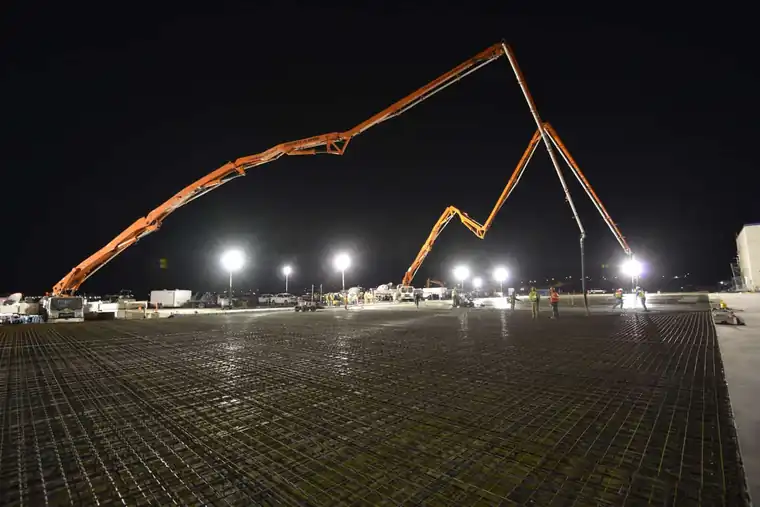
Poppoff's Lineage Logistics (PFS) building in Richland, Washington shows the scale. It is a 450,000 SF, 125' tall rack-supported building with 18" structural slabs. Three freezers totaling 315,000 SF were placed in 7 pours, to a flatness of FF75/FL45. The project later expanded to 5 freezers in 2019.
Easley Construction Inc., writing about its own Richland, WA freezer project, said Poppoff "was a key factor in the success" of it, and that "the quality of Poppoff's slabs are second to none."
Flatness is made in the first hours
A laser-guided screed strikes the fresh concrete to grade. A finishing crew then works the surface at the right moment as the slab stiffens, floating and troweling it. Mix design, weather and crew timing all push on the result, and a floor that gets behind on finishing rarely catches up. Poppoff's 2017 shop expansion in Moxee was sized to hold five concrete pumps and four laser screeds, which tells you what kind of equipment the company expects to put on a large floor.
Curing comes after finishing and is part of flatness, not an afterthought. If the top of the slab dries faster than the body, the edges can curl, and a floor that measured well on day one drifts out of tolerance. Protecting the surface while it gains strength is cheap compared with grinding a slab later.
What to ask before the slab is poured
- Which FF and FL values does the spec require, overall and as a local minimum, and who is taking the readings?
- How soon after finishing will the floor be measured, and what is the remedy if it comes in short?
- What do the racking and equipment suppliers require, in writing?
- How large are the pours, and do the pump and finishing equipment match that pour size?
- How is the crew sequenced so reinforcing, placement, screeding and finishing never wait on each other?
- What is the curing plan, and who is responsible for protecting the slab afterward?
Good answers to those questions matter more than a promise of a number. A contractor who can talk through pour size, screed setup and finishing sequence has usually done this before. Poppoff Inc. has placed and finished slabs from Moxee, Washington since 1977. If you have a flatness spec you want a second set of eyes on, call (509) 575-8353.
Poppoff, Inc., (509) 575-8353
Call (509) 575-8353More articles
Fewer Joints in Big Slabs: Ductilcrete and Macro Synthetic Fibre
Saw-cut joints protect a slab from random cracking, and they are also where the forklifts take their beating.
Renting a Concrete Pump vs. Hiring a Pump and Placement Crew
The machine is only half of the decision. The other half is who owns the pour once the concrete leaves the truck.